Top 40 private credit managers, 20 BDC ratings, sector exposure, leverage, default dynamics, and geographic distribution. Data sourced from PDI 200, S&P Global, Moody's, Fitch, KBRA, BIS, IMF, and Federal Reserve.
Section 01 — Visuals 1 & 2
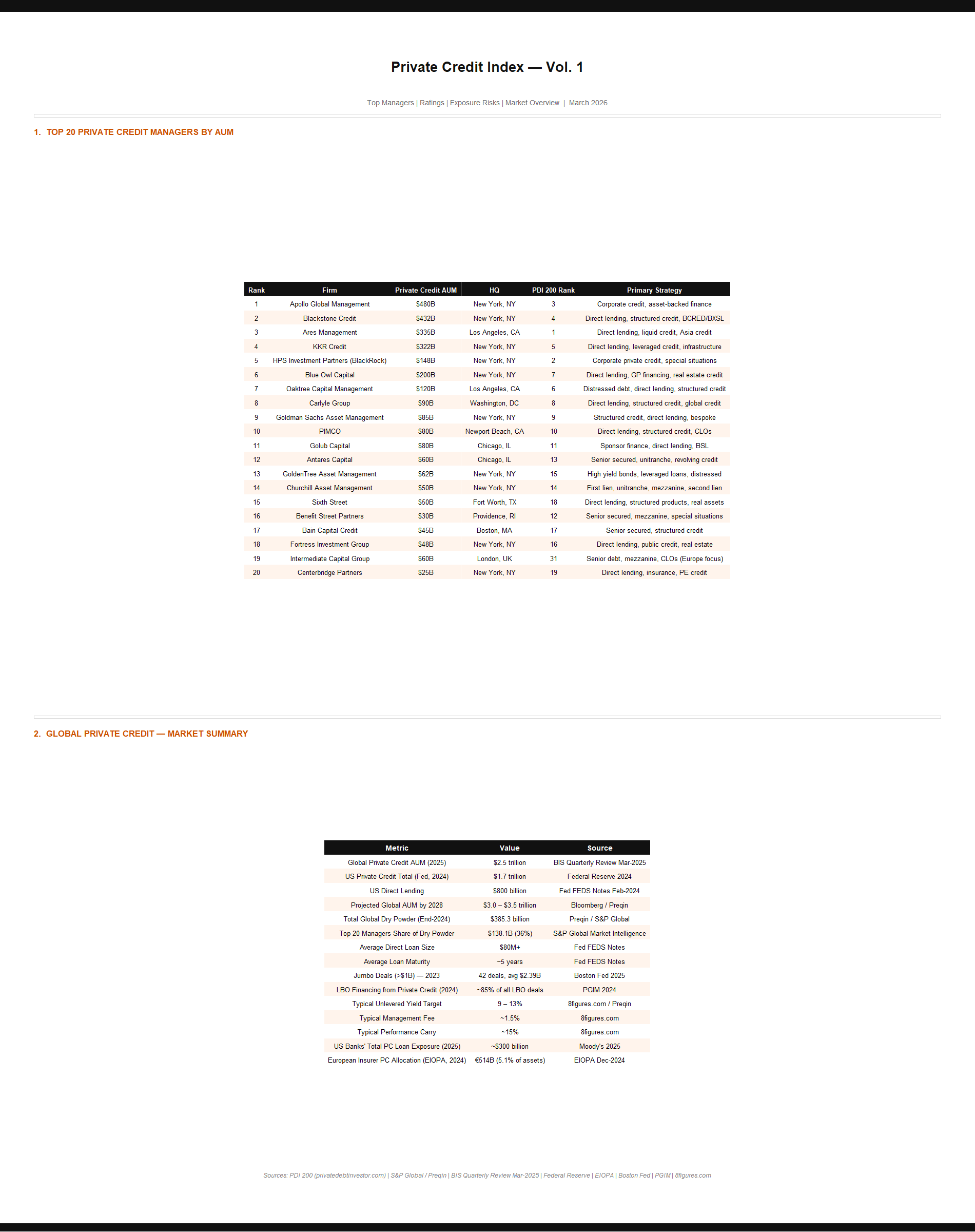
Private credit AUM in USD billions | Sources: PDI 200, company filings, S&P Global (2025)
Apollo ($480B) and Blackstone ($432B) are by far the two largest platforms, with Ares ($335B) and KKR ($322B) in close contention for third. The top 5 firms alone account for roughly $1.5T — an extraordinary degree of concentration at the upper end of the market.
| # | Firm | HQ | PC AUM ($B) | Primary Strategy | Geography |
|---|
Section 02 — Visuals 3, 4 & 5
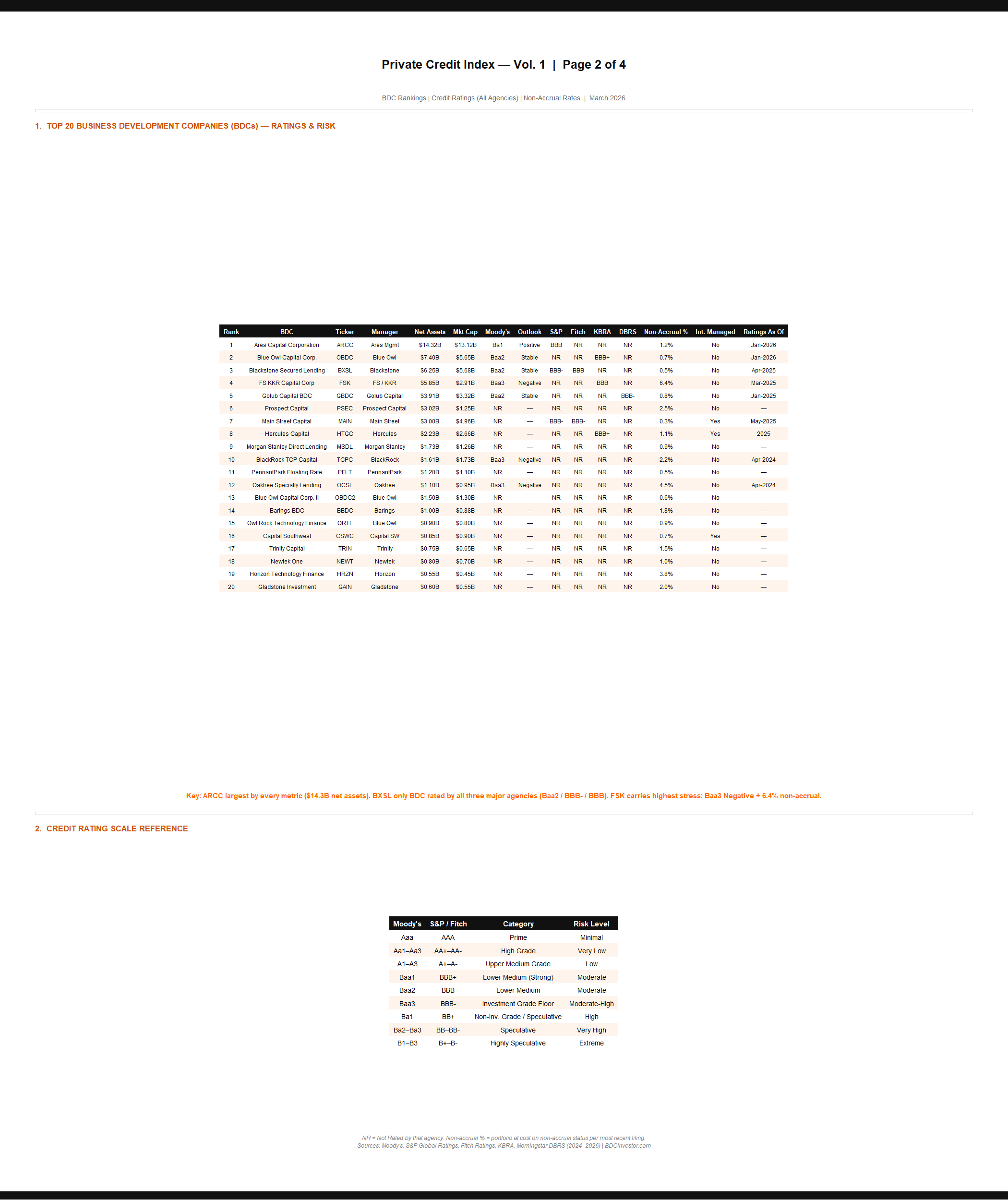
% of portfolio at cost on non-accrual | Sources: Company Q4 2024 / Q2 2025 filings
Points above diagonal = premium to NAV | Sources: BDCinvestor.com, filings (2024–25)
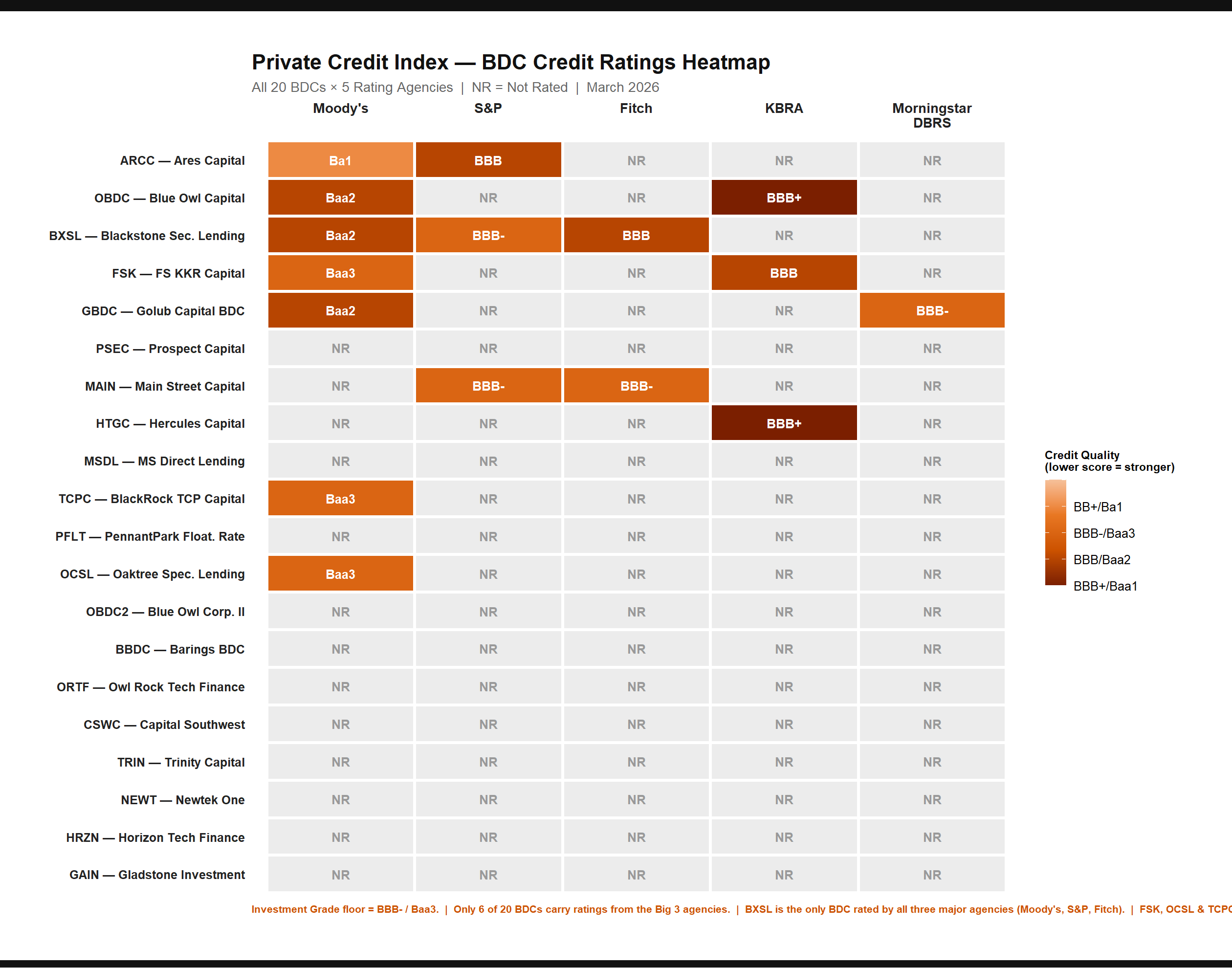
Investment grade = BBB-/Baa3 and above | NR = Not Rated | Sources: Moody's, S&P, Fitch, KBRA (2024–2026)
| Ticker | BDC Name | Manager | Net Assets ($B) | Mkt Cap ($B) | Moody's | S&P | Fitch | KBRA | Non-Accrual | Risk Tier |
|---|
Section 03 — Visual 6
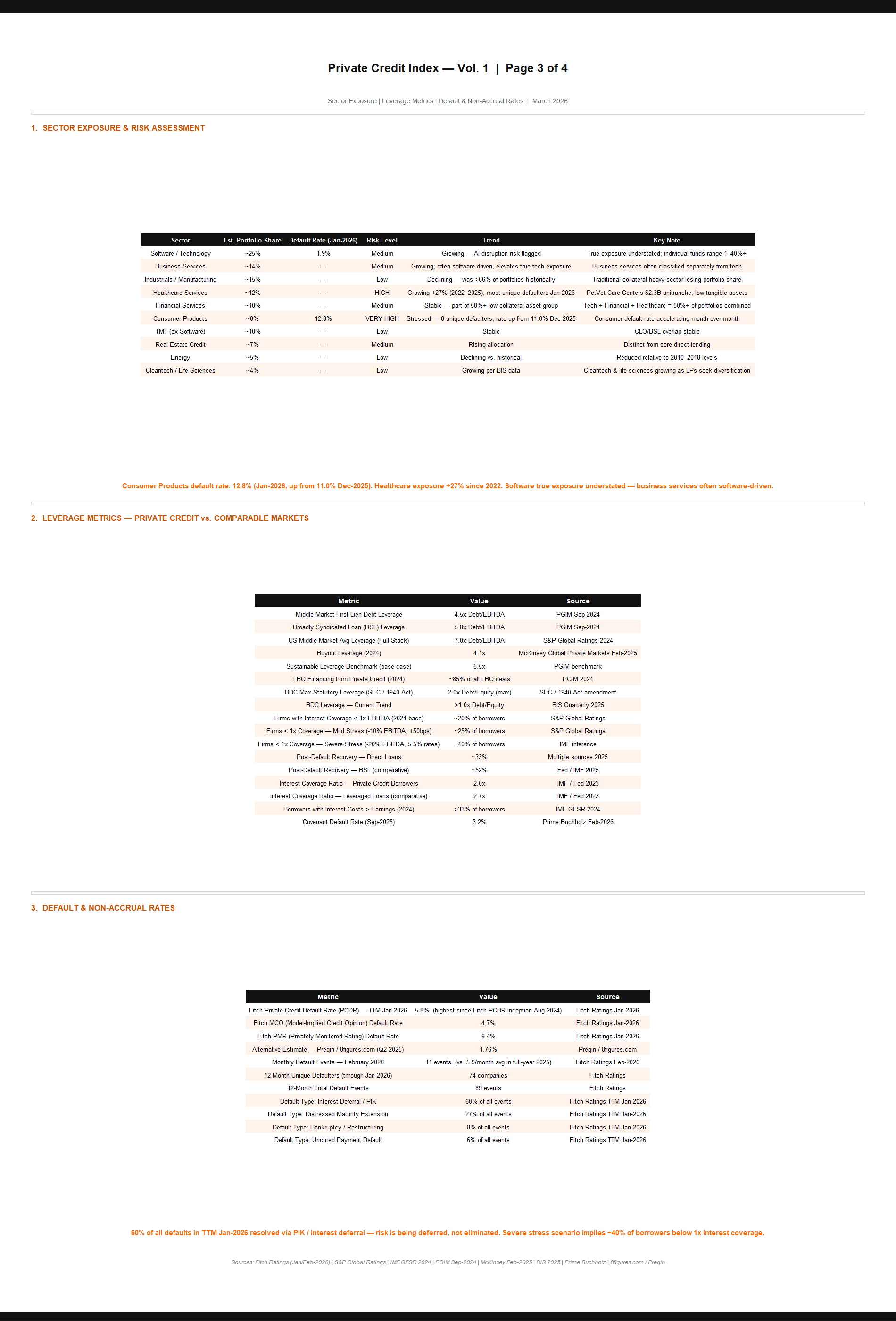
Estimated portfolio-weighted sector shares | Sources: S&P Global, Fed FEDS Notes, BIS, Prime Buchholz (2025)
Known default rates & risk classification by sector
| Sector | Share (%) | Default Rate | Risk Level |
|---|
Section 04 — Visuals 7 & 8
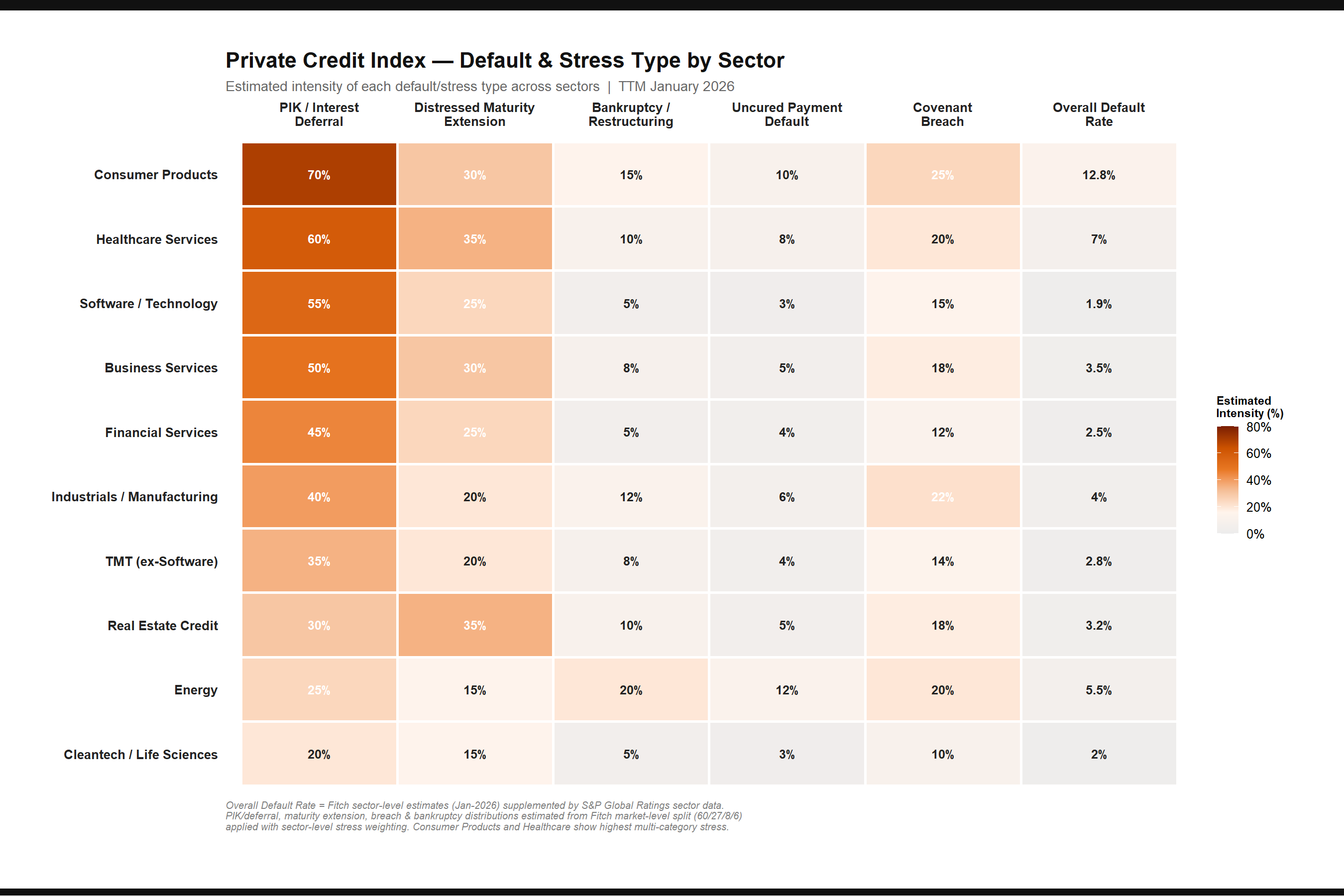
January 2026 | Fitch PCDR vs. sector and BDC-level rates | Sources: Fitch, Preqin, company filings
TTM through January 2026 (n = 89 events) | Source: Fitch Ratings
The overwhelming majority of private credit "defaults" are not outright bankruptcies — 87% are PIK interest deferrals or maturity extensions. This reflects the negotiated, bilateral nature of direct lending, where lenders can quietly restructure without triggering formal default events. Only 8% involve bankruptcy or restructuring and 6% uncured payment defaults.
Section 05 — Visual 9
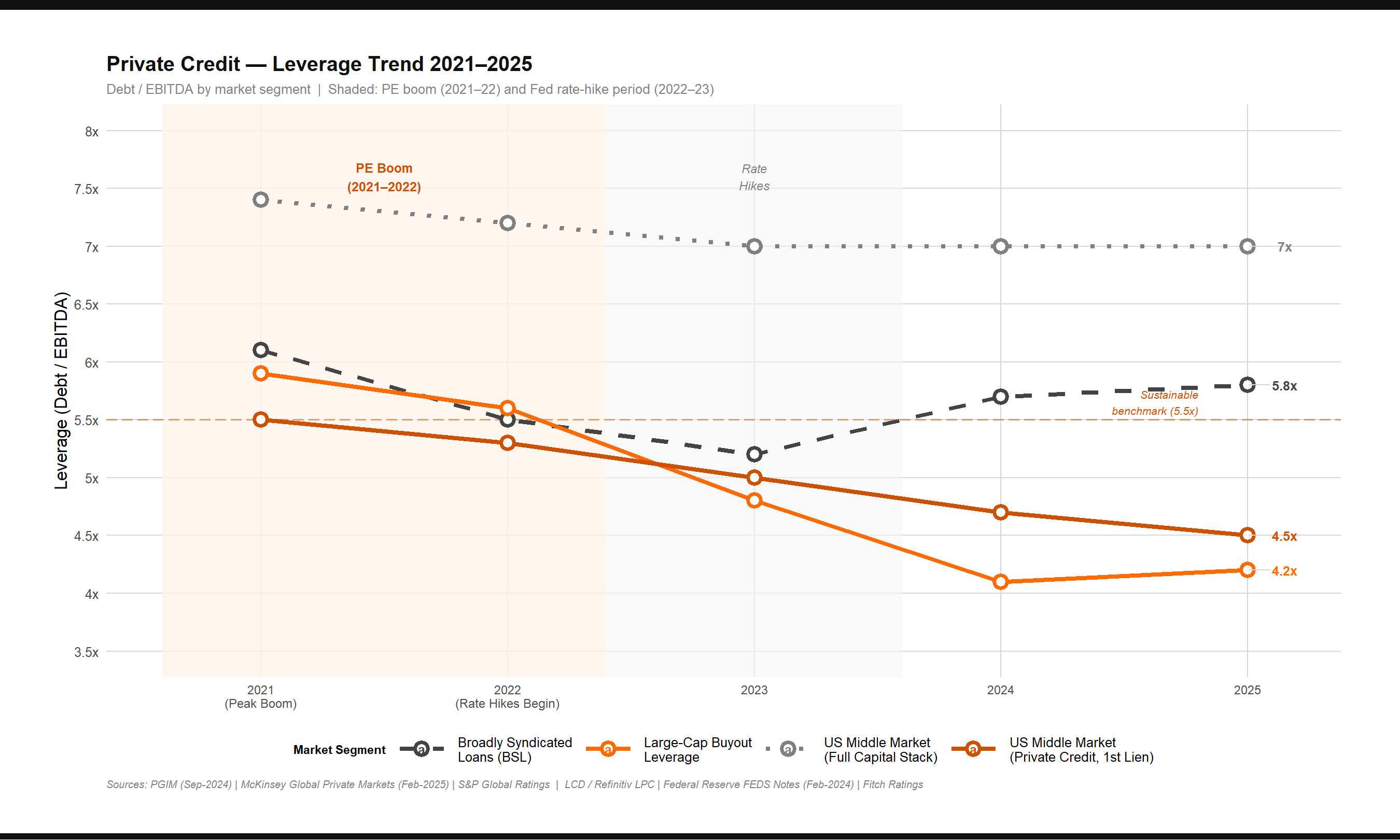
Debt / EBITDA ratios by instrument type (2024) | Sources: PGIM Sep-2024, S&P Global, McKinsey Feb-2025
US mid-market full-stack leverage at 7.0x is materially above the 5.5x sustainable benchmark, driven by aggressive unitranche structures. Broadly syndicated loans at 5.8x are also above the threshold, while buyout leverage (4.1x) and middle-market first-lien (4.5x) appear more disciplined.
Section 06 — Visual 10
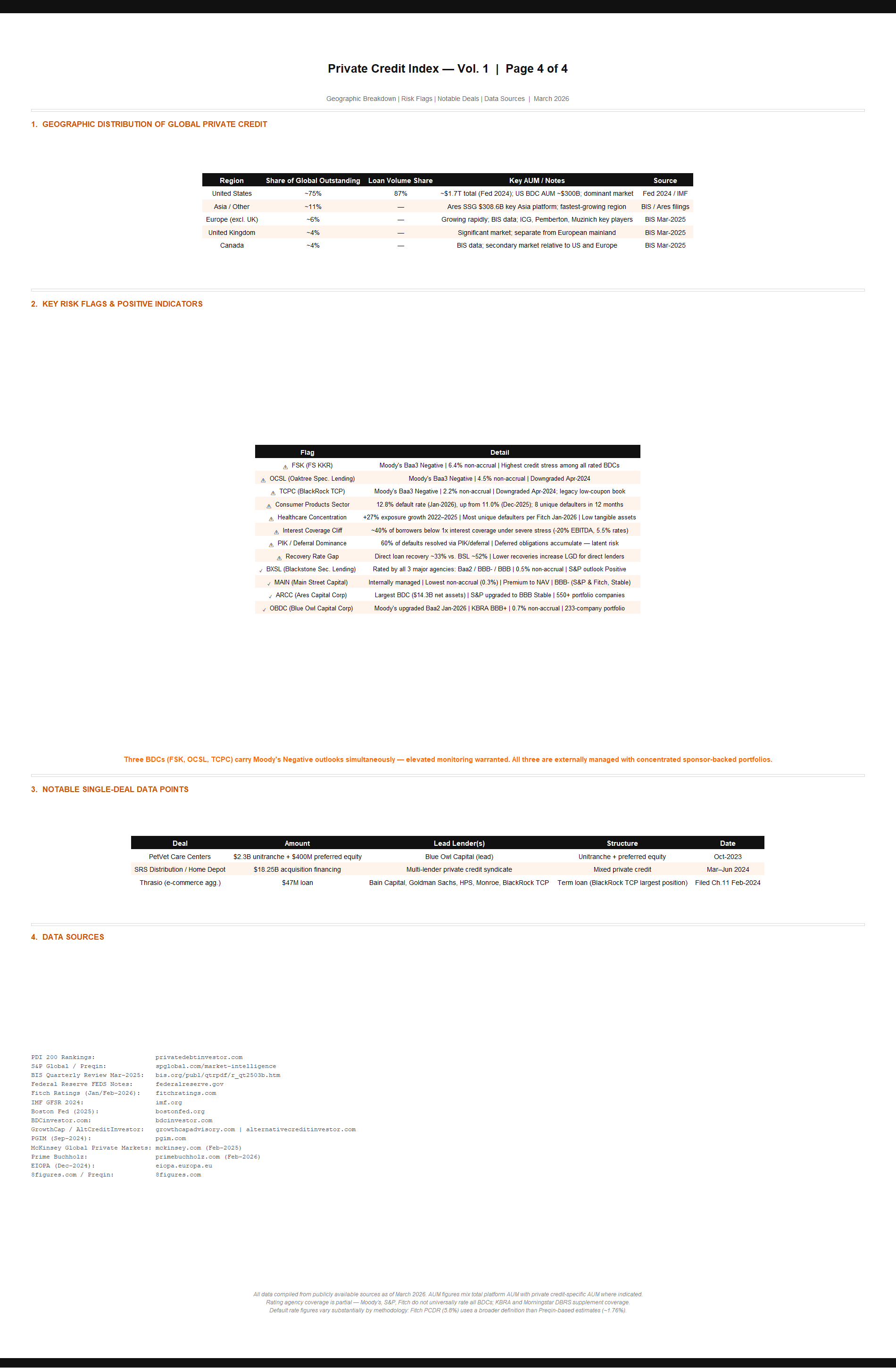
Share of global private credit outstanding (2025) | Sources: IMF GFSR 2024, BIS Quarterly Review Mar-2025
Count of top 40 managers by primary geographic focus
Section 07 — Visual 11
Bubble size = market cap | Color = management type | Sources: Moody's, S&P, KBRA, company filings (2024–2026)
ARCC ($14.3B net assets) and OBDC ($7.4B) dominate by size with relatively contained non-accrual rates. FSK stands out as an outlier with the highest non-accrual rate (6.4%) among rated BDCs despite its scale. Internally managed BDCs — MAIN, HTGC, CSWC — consistently show lower non-accrual rates, suggesting alignment between manager incentives and portfolio quality.